


Table of Contents
Why is BitChat trending in Uganda?
As Uganda approaches its general elections on January 15, 2026—just six days away—the political atmosphere is charged with anticipation, suspicion, and innovation. Opposition leader Robert Kyagulanyi, better known as Bobi Wine, has ignited a digital frenzy by urging Ugandans to adopt BitChat, a decentralized messaging app founded by tech mogul Jack Dorsey. This call comes amid fears of an internet shutdown by the ruling National Resistance Movement (NRM) government, a tactic employed in previous elections to stifle communication and dissent. BitChat, which operates without internet or cellular service, has surged in popularity, becoming a symbol of resistance against potential censorship.
However, the Uganda Communications Commission (UCC) has pushed back, with its Executive Director, Nyombi Thembo, asserting the government’s ability to block the app if it deems necessary. Dorsey’s cryptic response on X has only fueled the debate, drawing global attention to Uganda’s digital battleground. At Kampala Edge Times, we’ve delved into the app’s mechanics, its real-world applications, and the feasibility of blocking it, revealing why BitChat represents a formidable challenge to traditional control mechanisms.
What Sparked BitChat’s Sudden Popularity in Uganda?
BitChat’s rise in Uganda can be traced directly to Bobi Wine’s endorsement, framed as a proactive defense against anticipated government interference. On December 30, 2025, the National Unity Platform (NUP) presidential candidate urged his supporters to download the app: “We shall use it for communication in case the regime disables the internet ahead of the 2026 elections.” He elaborated on the government’s alleged motives, stating, “They switch off the internet to block communication and ensure that citizens do not organise, verify their election results, and demand accountability over the massive election theft.” This message resonated widely, leading to a spike in downloads and searches for BitChat in Uganda, where it quickly climbed app store rankings.
Wine’s call echoes past experiences; during the 2021 elections, Uganda endured a five-day nationwide internet blackout, which Wine described as a deliberate effort to suppress opposition voices. In a November 29, 2025, campaign speech in Masaka, he advised supporters to “find alternative ways to communicate when the internet is switched off. Prepare for how you will pass information when networks are blocked.” By promoting BitChat, Wine positioned it as a tool for sharing election materials, including Declaration of Results (DR) forms, without relying on vulnerable infrastructure.
The app’s appeal is amplified by Uganda’s history of digital restrictions. In 2021, the blackout disproportionately affected opposition activities, as noted in reports from international observers. Wine’s strategy has drawn parallels to global movements where offline apps have empowered citizens during crises. Downloads in Uganda surged, with BitChat becoming the second-most downloaded app in some regions, reflecting widespread anxiety over communication blackouts.
How Does BitChat Actually Work?
BitChat, launched by Jack Dorsey in July 2025, is a peer-to-peer messaging app designed to function without internet, cellular service, or central servers, making it inherently resilient to shutdowns. Dorsey, the co-founder of Twitter (now X) and Block, Inc., described the app’s origins when he shared details about spending time learning Bluetooth mesh networks before releasing the project’s whitepaper.
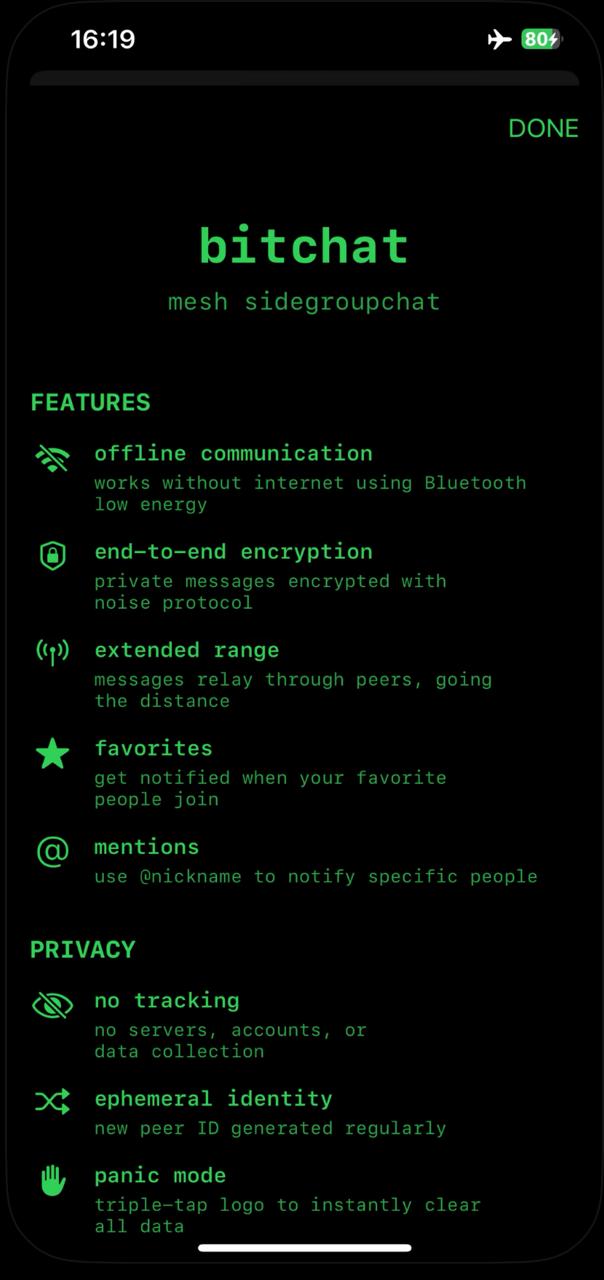
At its core, BitChat utilizes Bluetooth Low Energy (BLE) mesh networking, where each user’s device acts as both a sender and a relay. When a message is sent, it is encrypted and broadcast to nearby devices within about 30-100 meters. These devices then pass the message along to others, creating a chain that extends the network’s reach far beyond individual Bluetooth limits—potentially up to hundreds of meters in dense areas. Dorsey explained this in the project’s whitepaper: “Bitchat is a decentralized peer-to-peer messaging application that operates over Bluetooth mesh networks. No internet required, no servers, no phone numbers.”
In a video breakdown from July 17, 2025, Dorsey elaborated: “It’s a peer-to-peer offline messaging app, meaning it requires no internet or cell phone service because everything is transmitted via Bluetooth, specifically by using BLE or Bluetooth low energy protocol, which is very energy-efficient. Each phone acts both as a sender and relay, creating a network that extends far beyond the Bluetooth individual range.” The app supports ephemeral messaging, where communications can self-delete, and features end-to-end encryption using protocols like Noise XX for secure key exchanges. Users don’t need to share phone numbers or emails; connections form via geohash-based chat rooms or direct pairings.
This architecture draws from Dorsey’s broader vision for decentralized tech, as seen in his support for projects like Nostr and Bluesky. The app prioritizes privacy, requiring no phone number or email, and stores messages temporarily without centralized servers. While battery drain and range limitations exist, updates have added features like ASCII image conversion for low-data sharing, enhancing its utility in low-resource environments.
What Did UCC’s Nyombi Thembo Say About Blocking BitChat?
The UCC’s response came swiftly, with Executive Director Nyombi Thembo addressing the app’s promotion during a media briefing on January 5, 2026. Thembo downplayed BitChat’s invincibility, stating: “We know BitChat more than anybody in this country. The government has facilitated the regulator. We have the highest concentration of software engineers in this country, paid by the government for the public good… You can’t use BitChat to disrupt peace. If you are using BitChat for good, wonderful.” He emphasized the UCC’s capacity to “switch off such platforms if the need arises,” framing it as a measure to prevent misuse during elections.
Thembo’s comments were shared widely, where he asserted: “Don’t be excited by Bit Chat, it’s a small thing. We know it.” He warned that platforms spreading misinformation or inciting unrest would face regulatory action, regardless of their decentralized nature. This stance aligns with Uganda’s broader media guidelines for the elections, including bans on live streaming unofficial results or riots. Thembo’s confidence stems from the UCC’s technical team, which he described as capable of handling all telecommunications and networks.
How Did Jack Dorsey React to the UCC’s Claims?
Jack Dorsey’s response was characteristically succinct yet provocative. On January 6, 2026, he quoted a post about Thembo’s statements on X, simply replying: “interesting.” This one-word retort sparked a wave of reactions, with users highlighting the irony of attempting to block a Bluetooth-based app. One reply read: “Can someone bring him up to speed? Blocking BitChat means blocking Bluetooth itself.” Others mocked Thembo as sounding “like a clown,” underscoring the perceived futility of the threat.
Dorsey’s involvement with BitChat is rooted in his advocacy for censorship-resistant tech. In interviews and posts, he has positioned the app as a learning experiment in mesh networks and encryption, stating in a July 2025 release: “A decentralized peer-to-peer messaging app with dual transport architecture: local Bluetooth mesh networks for offline communication and internet-based Nostr protocol for global reach.” His “interesting” comment echoes past responses where he highlighted absurdities in tech regulation, drawing parallels to his critiques of centralized platforms.
Is It Truly Impossible for the UCC to Block BitChat?
Our investigation at Kampala Edge Times confirms that blocking BitChat effectively would be logistically and financially impractical, especially with elections mere days away. Unlike internet-dependent apps, BitChat relies on Bluetooth mesh, which operates device-to-device without centralized infrastructure. To disrupt it, authorities would need widespread Bluetooth jammers—devices capable of interfering with BLE signals.
However, jamming would indiscriminately affect all Bluetooth devices, including headphones, medical equipment, and vehicles, potentially causing chaos. Experts note that Bluetooth jamming would disrupt all BLE communications, not just Bitchat—unfortunately, no methods of mitigation can be applied. Deploying jammers nationwide, especially in urban areas like Kampala, would require installation in every building and public space, costing millions of dollars and taking years to implement effectively.
In dense populations, the mesh network’s redundancy—messages hopping across devices—makes targeted blocking even harder. With elections on January 12, any rushed attempt would be ineffective and could backfire politically. Similar efforts elsewhere have failed; for instance, governments have struggled to suppress apps like Bridgefy during protests due to their decentralized nature.
What Have Bobi Wine and President Museveni Said About NUP’s Strategies?
Bobi Wine has been vocal about countering government tactics, viewing BitChat as part of a broader fight for transparency. In his December 30 post, he stated: “Bitchat will enable you to communicate with thousands of people in record time. No internet connection is required. No sharing of phone numbers or email addresses. All you need to do is switch on Bluetooth and use the app.” He has also appealed to global figures for alternative connectivity, warning: “Democracy dies in darkness!”
President Yoweri Museveni, often referred to as M7, has dismissed opposition efforts with disdain. In a December 2025 statement, he remarked on Wine’s campaigns: “I really wonder sometimes when I see Bobi Wine campaigning, he knows very well that he cannot defeat me, but he keeps running up and down every time.” Museveni has accused NUP of disrupting peace, labeling their plans as futile. In reference to opposition strategies, he once quipped about Wine: “Ka-Bobi Wine,” implying diminishment. His regime has historically viewed NUP’s digital innovations as threats, with Museveni emphasizing stability over what he calls “disruptive” activities.
Despite Being New, How Has BitChat Proven Resilient in Global Crises?
Launched in July 2025, BitChat is relatively new but builds on proven technologies used in crises worldwide. Similar Bluetooth mesh apps like Bridgefy saw massive adoption during the 2019 Hong Kong protests, where over 100,000 downloads occurred amid fears of surveillance and shutdowns. Bridgefy enabled protesters to coordinate without internet, relaying messages across crowds and proving resilient to censorship.
BitChat itself has already demonstrated utility. During Hurricane Melissa in Jamaica in October 2025, it became the second-most downloaded app, facilitating encrypted communication when 70% of internet connectivity failed. In Nepal’s September 2025 anti-corruption protests, downloads spiked amid blackouts, allowing activists to share information securely. Briar, another mesh app, has been used in Cuba, Iran, and Myanmar for offline organizing during unrest.
Dorsey designed BitChat for such scenarios, noting its “store-and-forward” model ensures messages persist even if users go offline temporarily. As one analysis stated: “Bitchat is designed for resilient communication when traditional networks are unavailable or compromised, for example, during natural disasters or in regions with heavy internet restrictions.” In Uganda, its adoption mirrors these patterns, positioning it as a lifeline for election monitoring amid potential disruptions.
In conclusion, BitChat’s emergence highlights the evolving intersection of technology and politics in Uganda. As tensions mount, the app’s resilience could redefine how citizens navigate censorship, challenging the government’s control narrative. With elections looming, all eyes are on whether this Bluetooth-powered innovation will empower the people or invite further crackdowns. Kampala Edge Times will continue monitoring developments closely.
