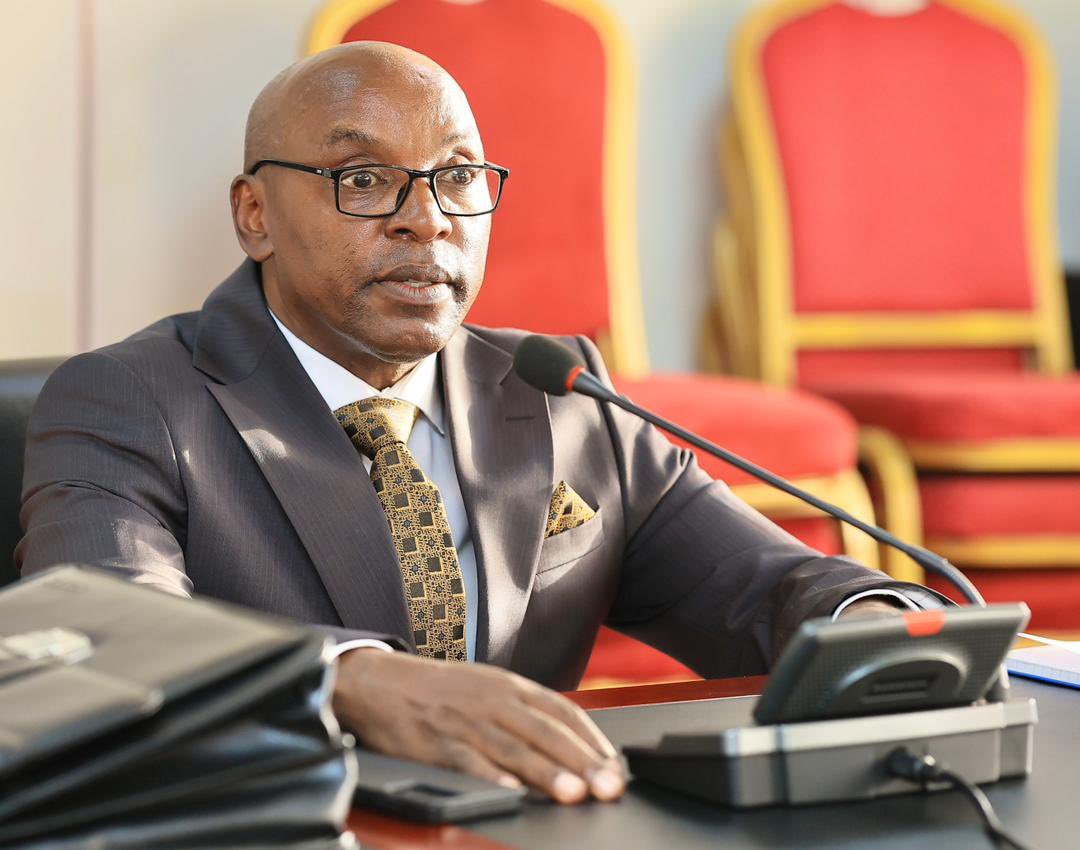
President Yoweri Kaguta Museveni has appointed Hon. Justice Flavian Zeija as the new Chief Justice of the Republic of Uganda, in a move that marks a significant moment for the country’s judiciary.
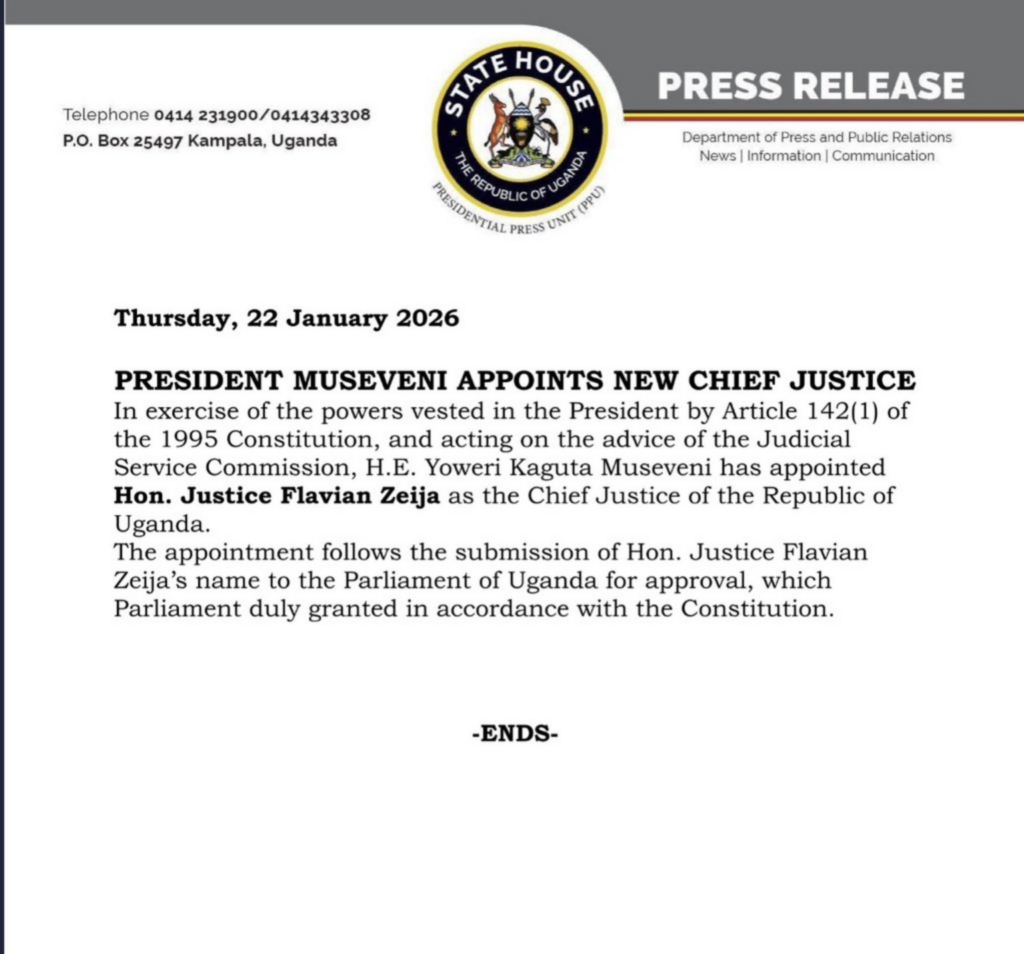
The appointment, announced on Thursday, January 22, 2026, was made in accordance with Article 142(1) of the 1995 Constitution. President Museveni acted on the advice of the Judicial Service Commission, as required by law.
According to the official statement from the Presidential Press Unit at State House, Justice Zeija’s appointment followed the submission of his name to the Parliament of Uganda for approval. Parliament subsequently vetted and approved the nomination in line with constitutional procedures, clearing the way for his elevation to the highest judicial office in the country.
Also Read: Spice Diana Officially Confirms Split from Manager Rogers
Justice Flavian Zeija brings to the role extensive experience within Uganda’s legal and judicial system, having served in various capacities over the years. His appointment is expected to provide continuity in judicial leadership while reinforcing the administration of justice and the rule of law.

As Chief Justice, Justice Zeija will head the Judiciary, preside over the Supreme Court, and play a central role in shaping Uganda’s legal landscape at a time when the courts continue to handle critical constitutional, electoral, and governance-related matters.
Whos is Justice Flavian Zeija?
Justice Flavian Zeija is a senior Ugandan judge and legal scholar who currently serves as the Chief Justice of Uganda. Before his appointment, he was the Deputy Chief Justice, a position he assumed in 2020. He comes from the Bakiga tribe.
He is widely respected for his deep knowledge of constitutional law, judicial administration, and legal reform. Justice Zeija is also an academic, having served as a law lecturer and contributed to legal scholarship in Uganda. Over the years, he has played a key role in strengthening judicial efficiency and promoting access to justice.
His career reflects a blend of courtroom experience, judicial leadership, and academic excellence within Uganda’s legal system.
The announcement concludes the formal process of appointing a new Chief Justice, ushering in a new chapter for Uganda’s Judiciary.
What is his educational background?
Born on February 18, 1969, Zeija attended local schools in Uganda, including St. Mary’s College Rushoroza, where he served as head prefect. He joined Makerere University in 1993, earning a Bachelor of Laws (LLB) in 1996. In 1997, he completed a Diploma in Legal Practice at the Law Development Centre in Kampala. He returned to Makerere for a Master of Laws (LLM) from 1999 to 2002. Zeija later obtained a PhD in Law from the University of Dar es Salaam and an MBA from Uganda Martyrs University.
What is his professional history as a jurist?
Zeija enrolled as an advocate of the High Court in 1998, beginning a career spanning over 25 years. He worked as a legal assistant at Kwesigabo, Bamwine, Walubiri & Company Advocates before becoming managing partner at Zeija, Mukasa & Co Advocates. He taught law at Uganda Christian University, Makerere University, and Makerere University Business School, where he founded the Business Law department. Appointed a High Court Judge in 2016, he served as Resident Judge of the Mbarara circuit, Uganda’s largest. In December 2019, he became Principal Judge, overseeing the High Court and magistrates’ courts. He was elevated to Deputy Chief Justice in February 2025 and assumed the Chief Justice role in January 2026. His progression has been described as one of the fastest in Uganda’s judicial history.
What is his personal background, including tribe and family?
Zeija hails from Western Uganda. While specific tribal details are not widely publicized, this area is predominantly associated with groups like the Banyankole and Bakiga. He is a father of five children and maintains a relatively private personal life. He is affiliated with organizations such as the Catholic Lawyers Society International, reflecting his commitment to ethical and faith-based legal principles.
How has President Museveni’s pattern of judicial appointments been criticized?
President Museveni’s appointments to key judicial positions, including the Chief Justice, have faced criticism for potentially undermining judicial independence. Critics argue that by appointing individuals to roles overseeing cases that could affect the executive, the process risks creating loyalty to the appointing authority rather than impartiality. This has led to concerns that the judiciary may function as a “rubber stamp” for the long-ruling government, with rare significant rulings against the president due to institutional dynamics and historical context.
Some observers note that such criticisms often highlight the concentration of appointment powers in the presidency, calling for more independent mechanisms like a dedicated judicial appointments commission. Others counter that these concerns overlook the judiciary’s need for stable leadership and that judges operate within constitutional frameworks, though the executive’s influence remains a point of contention.