Table of Contents
When is the NTV Presidential Debate 2025?
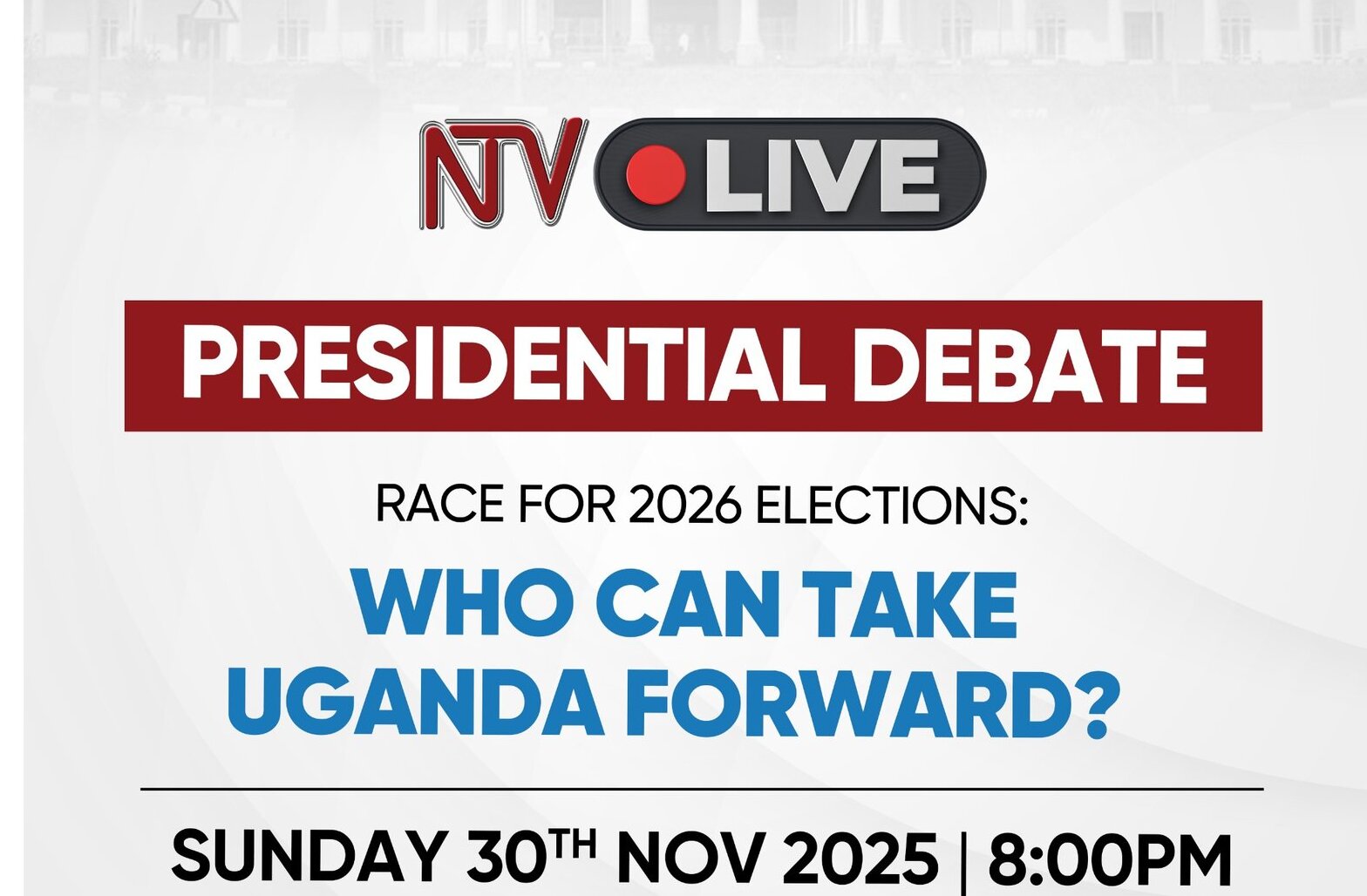
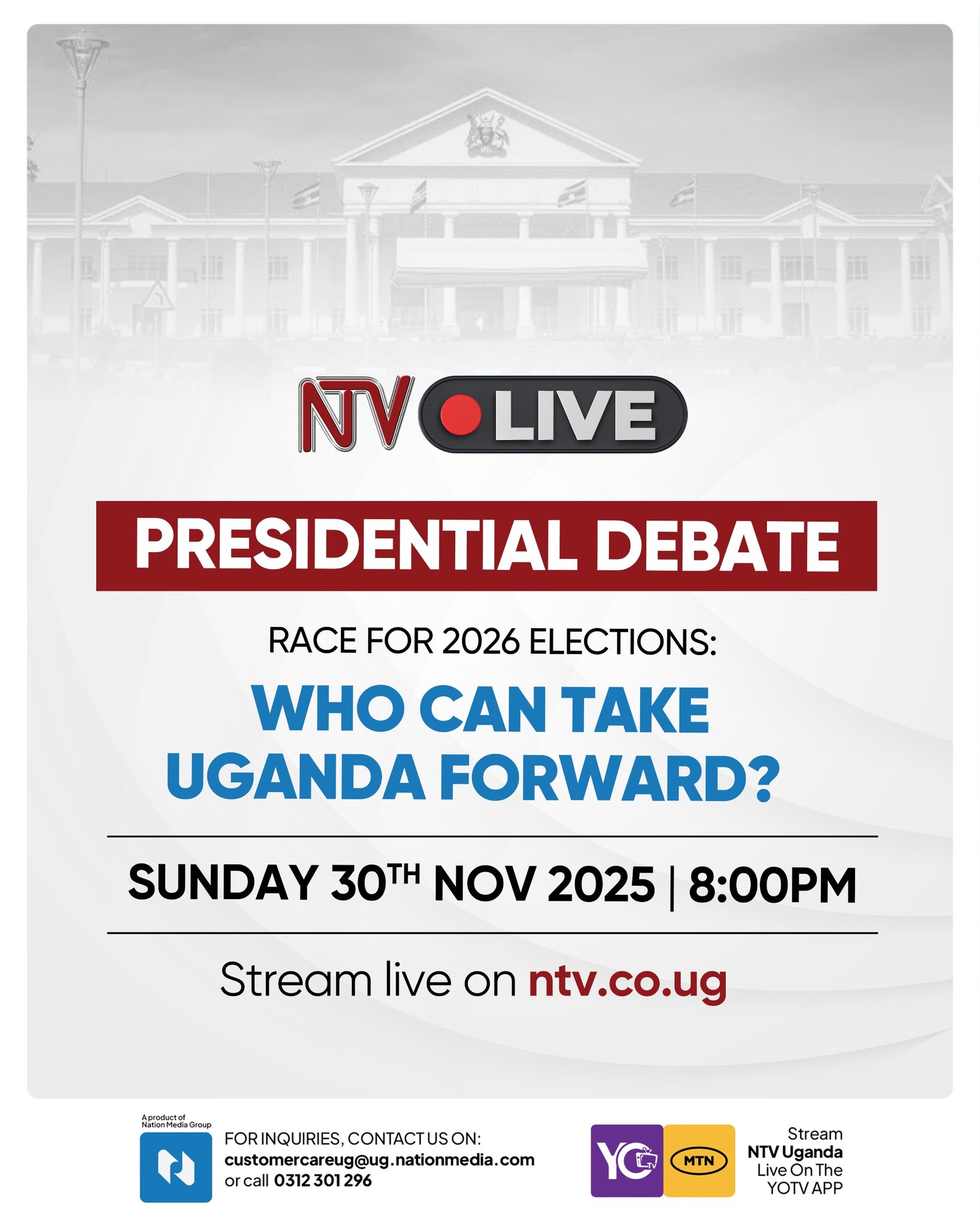
NTV Uganda has announced a presidential debate scheduled for Sunday, 30 November 2025 at 8:00 PM. That makes this debate historically significant: the last time a formal presidential debate was held in Uganda was nearly a decade ago, in 2016.
- The first televised debate took place on 15 January 2016 at Serena Hotel, Kampala. The moderators were Alan Kasujja and Nancy Kacungira. Seven candidates took part — but the then-incumbent Yoweri Kaguta Museveni did not attend.
- The second debate followed on 13 February 2016, also at Serena. This time, Museveni appeared. Moderators included Shaka Ssali (host of VOA’s Straight Talk Africa), Joel Kibazo, and Suzie Muwanga.
That 2016 debate was organised by IRCU together with The Elders Forum Uganda (TEFU), with support from United Nations Development Programme (UNDP). At the time, the organisers argued that the debates would offer “candidates a neutral platform to sell their agenda,” promote issue-based discussion rather than personal attacks, and give voters an opportunity to compare policies directly.
Since 2016, however, Uganda has not held a comparable presidential debate — including during the 2021 elections, when a 2020-2021 debate plan was abandoned. The 2021 exercise — also initiated by IRCU and partners — was postponed indefinitely because of “unforeseen constraints,” including the COVID-19 pandemic. That history helps explain why the 2025 debate — backed by credible institutions — is being framed as a moment of democratic renewal.
Who Is Behind the 2025 Debate?
NTV Uganda has announced the 2025 debate. Their stated aim is to institutionalise electoral debates — create a structured platform where all aspirants present their visions, and voters can make informed choices based on ideas and policies rather than personality politics alone. This approach draws directly from the 2016 model, which many observers consider the only precedent for an inclusive, nationwide presidential debate in Uganda. Still, there are many challenges: fear of manipulation (moderators being pressured), fairness of airing across media, and ensuring all candidates — including the incumbent — engage meaningfully.
The 2016 second debate itself was marred by controversy: according to Shaka Ssali, he was asked to moderate but not allowed to question Museveni directly — a condition allegedly demanded by the President’s camp. Given that context, the 2025 debate’s success will likely depend on transparency and the willingness of media, civil society, and candidates to hold to high standards.

Who Are the Eight Candidates in the 2025/26 Presidential Line-up?
The poster you shared lists eight presidential candidates. On 24–25 September 2025, the Electoral Commission of Uganda officially cleared these eight individuals to contest in the 2026 election. Below are profiles of each — their background, political party, and what they are broadly betting their campaigns on. Where available, I also note their main campaign priorities.
Yoweri Kaguta Museveni — National Resistance Movement (NRM)
- Museveni has been Uganda’s president since 1986 — over 35 years by the time of the 2026 elections.
- Under his NRM, the country has undertaken various infrastructure projects, development programs, and state-led initiatives. For 2026, his campaign reportedly leans on continuity — holding that his long experience and past accomplishments qualify him for another term.
- Critics often point to concerns over term limits, centralisation of power, and democratic space; supporters argue his leadership provides stability. This debate could offer an opportunity for these criticisms and defenses to be aired publicly.
Robert Kyagulanyi Ssentamu (Bobi Wine) — National Unity Platform (NUP)
- Bobi Wine is perhaps the best-known opposition figure in Uganda today. As leader of NUP, he draws much of his support from youthful and urban voters.
- His 2026 campaign emphasises anti-corruption, good governance, and a departure from decades-long rule by one man. Many see him as the face of generational change.
- However, Bobi Wine has lately publicly criticised some of the other opposition candidates — labelling them “fake” or “planted” by the ruling establishment to dilute the opposition vote.
Nathan Nandala Mafabi — Forum for Democratic Change (FDC)
- Mafabi is a seasoned politician, economist by training, and former longtime Member of Parliament. He is viewed as a veteran voice in Uganda’s opposition space.
- His campaign message centres on institutional accountability, transparent governance, and restoring democratic norms.
- In some regions (e.g. his home Bugisu sub-region), his nomination has been met with local enthusiasm and calls for “block votes” in his support.
Mubarak Munyagwa Sserunga — Common Man’s Party (CMP)
- Munyagwa is a lawyer and politician, former MP for Kawempe South (2017–2021), and previously served as Mayor of Kawempe Division (2011–2016).
- In early 2025 he became the leader of the newly rebranded Common Man’s Party (CMP) — formerly the Uganda Economic Party.
- His campaign rhetoric portrays CMP as “a force of ordinary Ugandans.” He promises constitutional reforms, civil-liberties protections, the release of political prisoners (including veteran opposition figures), and radical changes in governance.
- Some of his more controversial proposals include revisiting regional trade agreements and rethinking language policy (for example, he has reportedly questioned the emphasis on Swahili and suggested alternatives).
Frank Kabinga Bulira — Revolutionary People’s Party (RPP)
- Bulira is flagbearer for RPP. Publicly available information about his biography is limited compared to major candidates — but the party and his campaign emphasise systemic reforms and a break from traditional politics.
- His policy agenda reportedly includes decentralisation, structural reforms across governance, education, health, infrastructure, and a broader effort to provide new leadership approaches.
- For many voters, RPP and Bulira may represent a less-known “wild card.” Their ability to make an impact likely depends on how effectively they use the debate platform to pitch their vision.
Robert Kasibante — National Peasants Party (NPP)
- Kasibante (born 1988) is among the youngest candidates. He is an entrepreneur — founder and managing director of the Victory School of Beauty and Hospitality Management — and has a Bachelor’s degree in Business Administration and Master’s in Human Resource Management from Makerere University Business School.
- He represents the National Peasants Party (NPP), which aims to bring farmers and rural communities to the centre of national development.
- Key promises in his campaign include agrarian reforms, rural development, youth employment, skills training, and decentralisation — targeting inequality and improving livelihoods for Uganda’s rural majority.
- His platform positions him as a candidate for rural and youth empowerment, and as someone trying to shift attention away from elite urban politics.
Mugisha Gregory Muntu Oyera — Alliance for National Transformation (ANT)
- Gen. Muntu is a retired military officer turned politician. Born in 1958, he previously served in Uganda’s armed forces before transitioning to politics.
- He was once leader of the main opposition party Forum for Democratic Change (FDC), from 2012 to 2017. In 2018 he left FDC — citing ideological differences — and formed ANT in 2019.
- Muntu’s campaign rhetoric for 2026 emphasises national unity, inclusive development, a peaceful transition of power, and restoring integrity in institutions.
- Given his military background and credibility among parts of the electorate, some analysts view him as a serious “moderate” alternative — potentially appealing to voters looking for stability without incumbency fatigue.
Elton Joseph Mabirizi — Conservative Party (CP)
- Mabirizi previously ran for president in the 2016 elections (as part of the Independents Coalition), though he captured only a small share of the vote.
- In 2025 he was cleared by the Electoral Commission to run under the Conservative Party (CP) ticket.
- He has occasionally positioned himself as a “reformist” voice committed to cutting the size of government. In earlier statements he pledged to reduce the number of ministers if elected — arguing that Uganda’s government is bloated.
- As one of the lesser-known candidates compared to the big opposition leaders or the incumbent, his chances may hinge on how well he distinguishes his message during the debate and campaign season.
What Could the 2025 Debate Mean for Uganda?
With all eight candidates officially nominated and campaigning underway, the upcoming debate by NTV Uganda could offer Ugandans something they have not had in nearly a decade: a live, structured, public conversation where the candidates articulate — in real time — their visions, priorities, and responses to critical challenges facing the country. Given the diversity of candidates — ranging from long-time incumbents to youthful entrepreneurs, from former military leaders to rural-based agrarian candidates — this debate could:
- Provide clarity for voters about what each candidate stands for before casting ballots in 2026.
- Force candidates to respond under pressure — offering voters a chance to evaluate not only their ideas, but their poise, honesty, and readiness to lead.
- Strengthen democratic processes by normalising debates as part of election cycles.
- Reduce misinformation and personality-based politics by emphasising ideas, policy, and planning.
However, the success of this depends on fairness — including equal airtime, balanced moderation, and willingness of candidates (especially the incumbent) to engage meaningfully. The 2016 experience shows that these conditions are fragile.
Why Is This 2025 Debate Different?
- It comes nearly a decade after the last debate (2016) — breaking a long silence in televised presidential debates.
- It is organised in a political environment that appears more pluralistic — with eight officially recognised candidates representing a wider slice of Ugandan political, social, and generational diversity.
- Civil society appears more involved; the organisers are framing the debate as part of institutionalising civic dialogue rather than just a one-off media event.
- The stakes arguably are higher: Many Ugandans, especially youth, are looking for new leadership and tangible change.
What Should We Watch During the Debate?
As a journalist, a few of the most critical factors to observe will be:
- Moderator independence and fairness — Will moderators be able to treat all candidates equally, including the incumbent? The 2016 second debate was blemished by claims the lead moderator was under constraints.
- Media coverage and access — Will the debate be broadcast widely and simultaneously across major media platforms so all Ugandans can watch? Organisers have indicated this as a priority.
- Candidate participation — Will all eight show up? Will they commit to a full debate or pull out under pressure?
- Public reaction and engagement — Will viewers focus on ideas and policies, or social media degrade the debate into personality-driven polarisation?
- Follow-up — Will the debate lead to more structured political engagement (policy scrutiny, town halls, public discussions), or will it remain a symbolic event?
What Does the 2025 Debate Represent for Uganda’s Democracy?
The 30 November 2025 debate represents a potentially pivotal moment for Uganda’s democracy. For many, it is a chance to reopen the space for informed political dialogue, to shift the focus from long-standing power dynamics to real issues — governance, economy, youth employment, rural development, institutional reform, and more. For voters tired of hearsay, propaganda, or personality politics, this debate could be a rare opportunity to ask: What do you — the candidate — actually stand for? For the political class and media — it could mark the beginning of a more mature, issue-based election culture. How it unfolds will depend heavily on fairness, transparency, and the readiness of all actors — media, civil society, candidates — to play by democratic norms.