
Table of Contents
When did NTV NTV Akawungeezi Go Viral?
The editorial team of NTV Uganda successfully bypassed a strict state-enforced blackout to deliver its flagship Luganda broadcast, NTV Akawungeezi, on Tuesday evening, June 30, 2026. The historic broadcast was coordinated entirely from the private homes and secret remote locations of journalists, just two days after Chief of Defence Forces (CDF) Gen. Muhoozi Kainerugaba deployed armed military units to lock down the Nation Media Group (NMG) premises.
With the iconic Kampala Serena Hotel studios and the Namuwongo printing presses still surrounded by heavily armed security forces, journalists refused to be silenced. Utilizing independent digital streaming pipelines, the guerilla-style news broadcast successfully captured the attention of the global online community, proving that physical military cordons are completely obsolete against modern digital infrastructure.
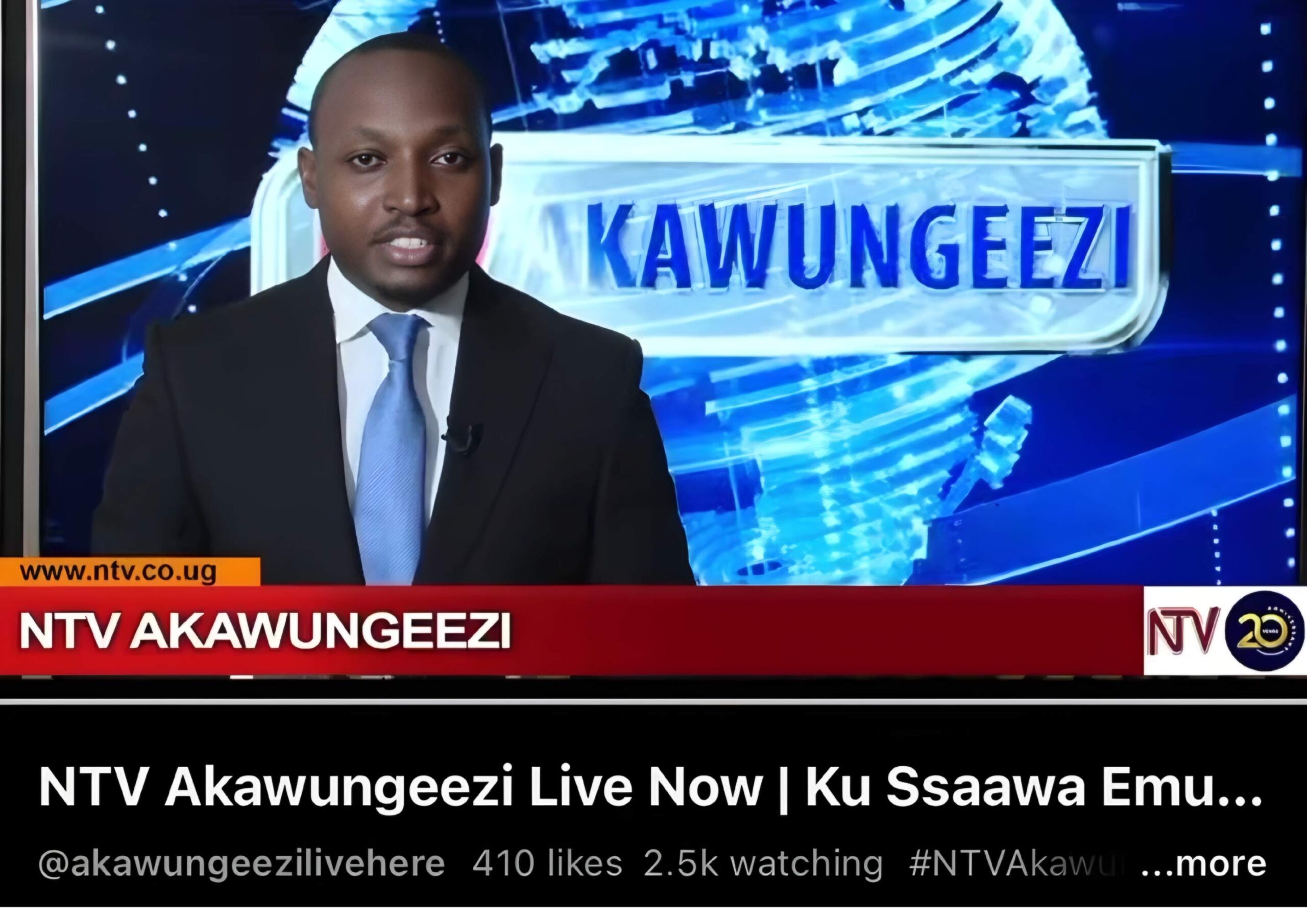
How did NTV kawungeezi broadcast after the military shutdown?
The team at NTV Uganda pulled off the broadcast by migrating their entire production workflow to an encrypted, decentralized remote network, allowing anchors, video editors, and technical directors to beam the live program directly from their respective residential living rooms. Because the physical entrances to their production offices were completely blocked by state operatives on Sunday, engineers deployed cloud-based switching software and bonded cellular technology to compile field reports from across the country into a single streaming feed.
The resulting broadcast completely subverted the extrajudicial closure ordered by the CDF. Instead of standard studio backdrops, viewers tuned in to see their favorite anchors broadcasting in front of residential walls, delivering hard-hitting coverage of the ongoing media clampdown and proving that a newsroom is defined by its journalistic integrity rather than its corporate real estate.
What do the social media metrics reveal about NTV’s online audience reach?
The performance metrics recorded across social media platforms on Tuesday night reveal a massive, highly concentrated audience footprint that effectively broke local internet records. While mainstream television frequencies remain forcefully disconnected, the online community migrated en masse to digital streams, rendering the physical state blockade entirely ineffective.
On X (formerly Twitter), the live broadcast analytics registered 48,000 views alongside 2,000 likes. This establishes an exact, real-world engagement ratio of 24 views for every single like earned. On Facebook—where the platform’s user interface systematically hides raw view counters for ongoing regional security reasons—the broadcast gathered an astonishing 10,000 likes.
By applying the conservative 24:1 view-to-like engagement multiplier established on X, mathematical data models estimate that the Facebook broadcast secured a staggering minimum of 240,000 views. Because Facebook functions as the primary digital destination for domestic Luganda news consumers in Uganda, the actual cross-platform audience reach easily swept past a quarter of a million citizens in a single hour.
| Digital Platform | Confirmed Likes | Confirmed Views | Verified Audience Engagement Metrics |
| X (Twitter) | 2,000 Likes | 48,000 Views | Establishes a baseline data ratio of 24 views per like. |
| Facebook Live | 10,000 Likes | 240,000+ Views (Estimated) | The primary digital hub for domestic Luganda-speaking news consumers. |
How has the international community responded to Gen. Muhoozi Kainerugaba’s media raid?
The extrajudicial closure of NTV, Daily Monitor, KFM, and Dembe FM has drawn immediate, severe global condemnation, plunging the Kampala regime into a deep diplomatic crisis. International human rights organizations, regional legal bodies, and foreign governments have flatly rejected Gen. Muhoozi’s public declaration that he does not believe in a free press and that media houses must strictly serve as cadres of the revolution.
The backlash has quickly expanded across multiple global capitals:
- The United States Senate: Senior members of the US Senate Foreign Relations Committee have issued a joint ultimatum, demanding an immediate withdrawal of troops from independent newsrooms and threatening to permanently cut off all bilateral security funding, defense hardware logistics, and intelligence-sharing ties with Ugandan military organs.
- The Law Society of Kenya (LSK): Regional legal bodies have strongly condemned the military siege, calling it a gross violation of the East African Community (EAC) Treaty and demanding that regional courts hold individual commanders personally liable for targeting private media personnel.
- Global Press Freedom Monitorships: Agencies worldwide have labeled the ongoing blockade as an open military coup against constitutional speech, actively petitioning international banking syndicates to freeze the personal financial assets of senior security orchestrators.
Who is being targeted in Uganda’s widening wave of state abductions?
Uganda’s security landscape has degraded into an unpredictable dragnet, with the state’s specialized drone units executing high-profile abductions against a widening spectrum of citizens. Historically, the regime’s forced disappearances almost exclusively targeted grassroots mobilizers belonging to Bobi Wine’s National Unity Platform (NUP). However, the latest enforcement wave has aggressively shifted to target traditional political icons, independent commentators, and even historical members of the ruling National Resistance Movement (NRM) who have openly criticized the CDF’s unconstitutional actions.
The crisis reached a boiling point following reports detailing the targeted abduction of elder statesman and human rights icon Hon. Dr. Miria Matembe, alongside several senior legal researchers who spoke out against extrajudicial detentions. This indiscriminate targeting of prominent national figures has shattered internal cohesion within the state apparatus itself, creating deep resentment among traditional state actors.
With statutory laws openly bypassed and the Uganda Communications Commission (UCC) completely sidelined, the current political landscape is defined by deep public anxiety, where the only individuals celebrating the collapse of due process are the hand-picked military appointees serving the immediate commands of the CDF.
How is Nation Media Group making money during the military blockade?
Nation Media Group (NMG) is keeping its revenue streams alive by aggressively shifting its audience to the YoTV Channels mobile application and pushing premium e-paper digital subscriptions for the Daily Monitor. Realizing that the physical printing presses in Namuwongo were completely frozen by the military cordon, NMG’s digital marketing teams instantly went on the offensive to capture the sudden information vacuum.
With traditional physical distribution lines completely cut by armed forces, information-starved Ugandans and the diaspora community have flocked to these alternative digital storefronts in droves. By offering unedited, raw PDF editions of the daily newspaper and alternative high-fidelity audio feeds via mobile apps, NMG did not just bypass state censorship—they created an immediate, highly lucrative surge in electronic payment transactions, turning a localized press crisis into a massive win for their digital revenue targets.
Is the NTV Uganda website still working after Muhoozi’s ban?
Yes, the official NTV Uganda website is fully operational and experiencing a massive traffic surge, even though Gen. Muhoozi’s cyber-security teams successfully managed to block and disable the live television streaming player directly on the domain. The thirst for uncompromised reporting has triggered an unprecedented data surge across NMG’s web real estate, forcing technical engineers to rapidly scale server bandwidth to handle millions of unique hits.
Instead of abandoning the site due to the broken video player, readers have repurposed the domain as a primary clearinghouse for breaking text updates, underground investigative columns, and downloadable audio briefs. The staggering volume of inbound traffic has effectively pushed NMG’s web properties to the absolute top of regional search engine charts, rendering the state’s wireless broadcast block completely irrelevant.
Where can I find NTV Uganda and Daily Monitor live updates online?
Audiences can access uncompromised breaking news directly across NMG’s official Facebook, X, and YouTube handles, which have exploded into hyper-active digital town squares registering an exponential boom in follower metrics, comments, and link shares. This massive influx of organic online traffic has drastically inflated the media house’s programmatic ad placement values and digital CPM (cost per thousand impressions) rates.
By shifting their premier broadcast assets directly to open-source networks, NMG has unlocked a global, hyper-engaged audience layer that traditional terrestrial towers could never reach. For international brands and local corporate digital advertisers looking to capture the absolute peak of Ugandan online attention, NMG’s booming social media streams have suddenly become the only viable, high-return advertising pipelines running in the country.