
Table of Contents
KAMPALA, Uganda — In a blistering economic critique and public call to action, sports administrator, investor, and commentator Joseph Mbazzi Muguluma, widely known as Immanuel Ben Misagga, has challenged the political and business leadership of Western Uganda to stop relying on raw agricultural sales and build an industrial empire around the iconic Ankole Long-Horn cow.
Titled “ANKOLE: THE VALLEY THAT CRIED IN ITS SLEEP,” Misagga’s reflection warns that despite enjoying four decades of continuous peace, modern tarmac road networks, and government poverty-alleviation programs like NAADS, Operation Wealth Creation (OWC), and the Parish Development Model (PDM), the Ankole region risks leaving its youth stranded in poverty while local wealth drains away.
Writing from Kifuuta in Kyotera, Buddu, the former SC Villa president argues that while neighboring Buganda mobilized its population under Katikkiro Charles Peter Mayiga to plant millions of coffee trees through the “Emwanyi Terimba” campaign, Ankole’s elites spent decades drinking traditional banana-sorghum brew (Enturire), debating politics on radio talk shows, and selling raw milk in plastic jerrycans.

To reverse this trajectory, Misagga has laid out a detailed blueprint dubbed “The Ankole Revival” or “The Ankole Chocolate Manifesto.” The plan proposes planting cocoa across nine districts in Western Uganda, establishing an “Ankole Gold” chocolate processing plant in Mbarara, and building modern leather, tinned beef, and T-bone steak factories along the Rwizi basin.
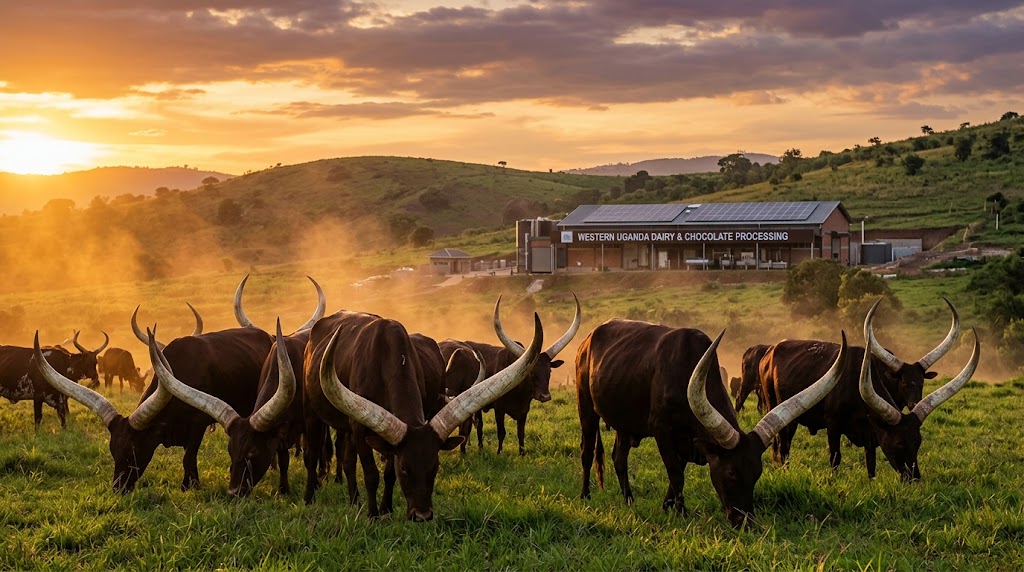
What is the forgotten covenant of the Ankole Long-Horn cow?
Misagga opens his manifesto by examining the historical and economic foundation of Western Uganda, arguing that the region’s true competitive advantage was never in copying crops suited for other soils, but in livestock value addition.
“In the beginning, God did not give Ankole matooke. He did not give us rice. He gave us THE COW,” Misagga writes. “The Ankole Long-Horn. Horns like the moon. Milk like honey. Skin that kings in Cape Town pay $10,000 for one animal. That was our covenant. Our Swiss watch. Our gold mine that walks and breathes.”
However, Misagga laments that instead of refining this native endowment into processed, high-value consumer products, the region abandoned its historical staples like millet, copied matooke farming from Buganda, and began importing rice from neighboring Tanzania while fertile valleys sat underutilized.
While peace and state funding opened doors for agricultural expansion, local leaders and farmers kept cattle in basic kraals, selling unprocessed milk for farmgate prices and exporting live animals instead of processing meat and leather locally.
How do global leaders like Lee Kuan Yew, Paul Kagame, and Katikkiro Mayiga compare to Ankole’s progress?
To prove that economic transformation depends on local initiative rather than waiting for central government directives, Misagga contrasts Western Uganda’s four decades of hesitation with transformative figures across Africa and Asia:
- Lee Kuan Yew (Singapore): Took a small island nation with no fresh water or mineral resources and turned it into Asia’s financial capital without waiting for Malaysia or external aid.
- Deng Xiaoping (China): Declared a small fishing village in Shenzhen a Special Economic Zone, transforming it within 40 years into a global manufacturing metropolis of 17 million people.
- Paul Kagame (Rwanda): Rebuilt a devastated nation after 1994 by branding “Rwandan Coffee” into global chains like Starbucks and positioning Kigali as a clean, digital hub.
- Nana Akufo-Addo and the Otumfuo (Ghana): Developed local cocoa processing to make Ghana the second-largest global producer, establishing “Made in Ghana Chocolate” in European retail markets.
- Narendra Modi (Gujarat, India): Championed local dairy co-operatives like Amul in his home state, transforming a regional milk network into a $10 billion global dairy brand.
- Katikkiro Charles Peter Mayiga (Buganda Kingdom): Launched the 10-year “Emwanyi Terimba” campaign across Buganda, mobilizing households to plant coffee, establish kingdom export channels, and build processing brands without waiting for State House interventions.
Misagga points out a clear pattern among successful economies: great leaders do not export raw materials, nor do they spend time in endless political debates. They take whatever natural resources exist in their region and build global consumer brands around them.
How does Ankole’s raw milk economy compare with global agricultural giants?
To emphasize the financial losses caused by selling raw produce, Misagga compares Ankole’s resource utilization against international economies that built multi-billion-dollar industries from basic endowments:
- Switzerland: Lacking oil or mineral wealth, the Swiss combined cattle farming with cold climates to create a $200 billion global industry in chocolate and precision watches. By contrast, Ankole sells raw milk in jerrycans.
- France: Capitalized on native grape vineyards to produce luxury Cognac selling for over $500 a bottle. In contrast, Ankole consumes its rich dairy output mixed into basic tea.
- Gujarat (India): Built the Amul dairy cooperative into a $10 billion commercial entity, whereas Ankole has failed to establish an internationally recognized dairy brand.
- Buganda: Turned its fertile soils into commercial coffee farms and export brands, while Ankole abandoned indigenous food production to copy matooke and import Tanzanian rice.
What is the four-point plan outlined in the Ankole Chocolate Manifesto?
To turn four decades of unfulfilled potential into a modern industrial economy, Misagga outlines four concrete steps to transform Western Uganda into a commercial power:
1. Mass Cocoa Cultivation Across Nine Western Districts
Misagga calls for massive cocoa planting across Bushenyi, Ntungamo, Rubirizi, Bundibugyo, Ibanda, Isingiro, Rubare, Nyakabande, and Ntoroko. By combining local cocoa production with Ankole’s abundant milk supply, the region can establish a distinct milk-chocolate identity.
Also read about Balaam public corruption hunt
2. Build the ‘Ankole Gold’ Chocolate Plant in Mbarara
Establish a state-of-the-art processing facility in Mbarara City to manufacture branded “Ankole Gold” chocolate bars and dairy products packaged for export to markets in the Middle East, Europe, and across Africa.
3. Establish T-Bone Steak and Leather Processing Factories
Stop selling live cattle for UGX 2 million at local farmgates. Instead, construct modern abattoirs and tanneries along the Rwizi basin to process premium $50 T-bone steaks for high-end hospitality markets, while converting cow hides and horns into luxury leather bags and handcrafted goods worth $500 in international retail stores.
4. Launch ‘Rwizi Tinned Beef’ Across Regional Markets
Produce shelf-stable “Rwizi Tinned Beef” to supply retail supermarkets from Kampala to Kigali and beyond, establishing an East African food brand capable of competing with imported processed meats.
Why does Ben Misagga say citizens cannot blame President Museveni for empty factories?
Addressing local leaders, farmers, and youth directly, Misagga rejects the habit of blaming central government leadership or State House for the absence of regional industries.
He notes that with peace secured, electricity distributed, tarmac highways connected, and development funds released through PDM and OWC, the responsibility for building local factories rests squarely on the shoulders of the region’s entrepreneurs and community leaders.
“You cannot blame Museveni for your sleeping in Enturire. You cannot blame the radio for empty factories. You can only blame the mirror,” Misagga states. “Lee Kuan Yew didn’t wait. Deng didn’t wait. Kagame didn’t wait. Mayiga didn’t wait. Why are we waiting?”
Closing his manifesto, Misagga warns the current generation that history will judge them harshly if they fail to turn their rich heritage into sustainable wealth for their children:
“20 years from now, your grandchild will ask: Jjaajja, Kaaka, when God gave you the cow and 40 years of peace, what did you build? What will your answer be? Will it be factories? Or will it be silence as you sip Enturire? The valley is still fertile. The cow is still sacred. But the clock is ticking.”