

Table of Contents
What happened at the Musevenomics lecture with Dr Okello Sharon Nagenjwa?
Kyambogo University temporarily shifted its campus identity this week, transforming from an academic lecture destination into an intense economic activation hub. Students completely filled the lecture hall for the latest edition of the Heart to Harvest Lecture Series, demonstrating an level of attentiveness usually reserved for urgent survival instructions.





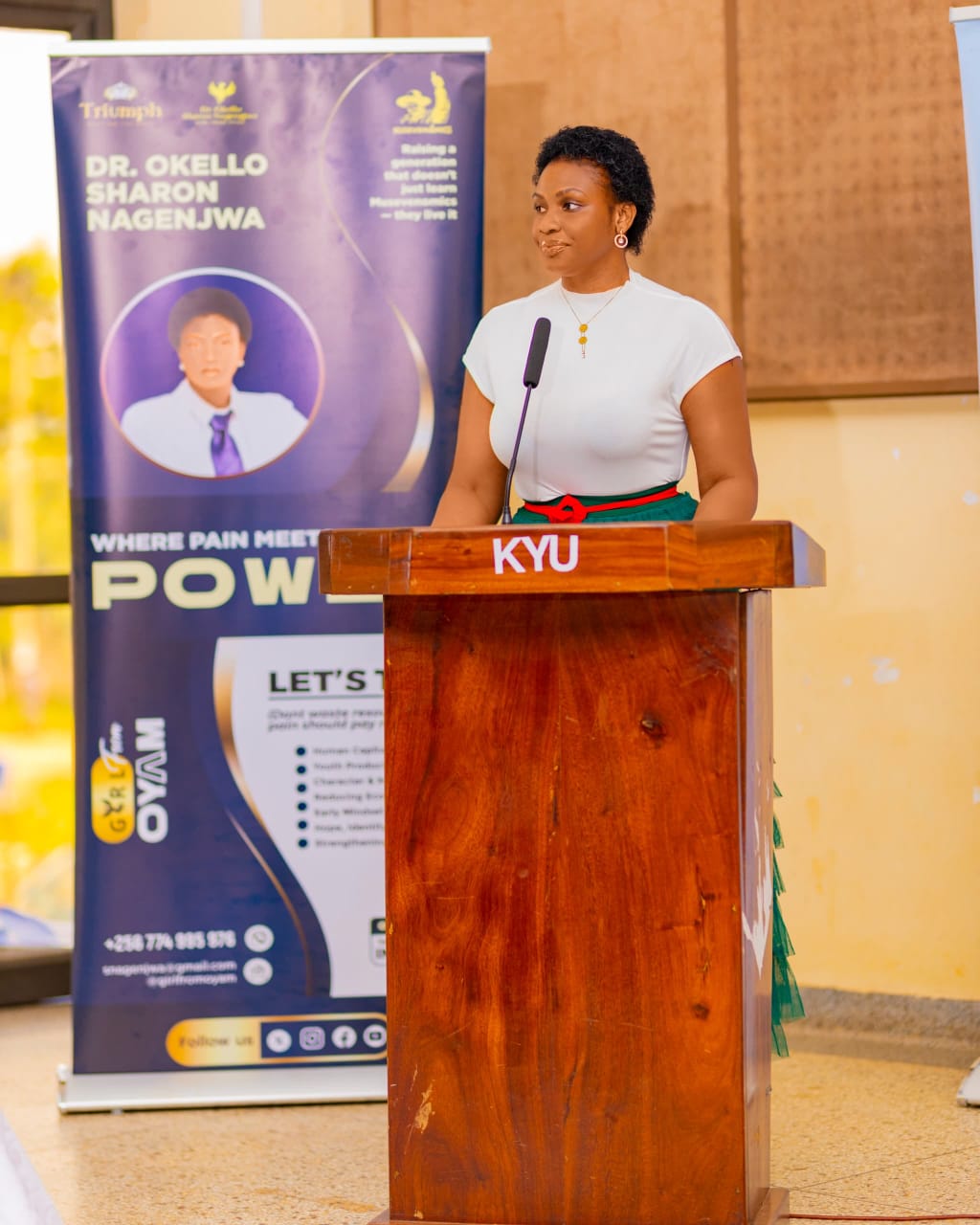
During the session, mobile devices were deployed exclusively for comprehensive note-taking rather than standard social media browsing. The atmosphere maintained a unique balance of intense concentration and sudden corporate laughter, as deep economic principles were delivered through highly relatable, real-world analogies.
Also read about Doctor Sharon
From the front-row enclosures to the active participation of students with disabilities, the engagement underscored a core baseline of the gathering: that personal productivity, intellect, and value creation carry absolutely no physical limitations.
What is the Heart to Harvest Lecture Series and the Musevenomics framework?
The Heart to Harvest Lecture Series is a specialized youth empowerment and mindset alignment platform founded by Dr. Okello Sharon Nagenjwa under the auspices of Triumph Women Uganda. The initiative focuses on economic activation, corporate leadership development, psychological mindset transformation, and practical wealth-creation Blueprints designed for the next generation of African entrepreneurs.
This particular campus edition centered on the strategic execution theme of “How To Make Money Without Money.” The curriculum utilized the formal framework of Musevenomics—an intensive macroeconomic and socio-economic paradigm originally authored by President Yoweri Kaguta Museveni.
To make the philosophy actionable for grassroots demographics and youth structures, the framework has been systematically packaged and decentralized under the strategic coordination of General Akandwanaho Salim Saleh (Caleb Akandwanaho). The doctrine treats human resource activation as the initial layer of national industrialization.
How can young people leverage self-worth into financial capital according to Dr. Sharon Okello?
Delivering the keynote lecture, the CEO of Triumph Women Uganda, Dr. Okello Sharon Nagenjwa, initiated the training session with a collective identity declaration:
“I am value.”
Dr. Nagenjwa explained that Musevenomics functions primarily as a human-centered economic doctrine which states that sustainable wealth generation must begin with internal self-activation long before external financial capital or bank facilities arrive. She challenged the systemic victim mindset prevalent among modern graduates, stating plainly, “Many young people are sleeping factories introducing themselves as unemployed.”
[Internal Self-Activation] ➔ [Value Creation Matrix] ➔ [External Capital Attraction]
Using personal storytelling, scriptural references, and lived corporate experience, the keynote speaker outlined five foundational resource transformations that any student can execute immediately without upfront financing:
- Voice to Infrastructure: Deploying personal communication assets to build institutional networks.
- Confidence to Currency: Utilizing psychological assertiveness to negotiate entry into commercial ecosystems.
- Pain to Platform: Turning historical or socio-economic hardships into unique, relatable market solutions.
- Visibility to Income: Leveraging personal or digital placement to attract commercial brand attention.
- Discipline to Economic Power: Enforcing strict lifestyle boundaries to protect early operational margins.
To illustrate the misuse of modern technology, Dr. Nagenjwa highlighted a common societal paradox regarding smartphone utilization. She noted that while a vast demographic of youth own premium, highly advanced smartphones, they limit their utility to interpersonal gossip, tracking past relationships, and broadcasting generic morning greetings.
Conversely, a distinct class of innovative young minds leverages the exact same hardware and data networks to construct digital storefronts, manage logistics, audit freelance channels, and build scalable corporate brands.
“The problem is sometimes a sleeping mind inside a fully charged phone,” she observed.
What are the three stages of wealth creation taught under the Musevenomics doctrine?
The instructional core of the lecture evaluated the structural progression of asset accumulation. Under the Musevenomics paradigm, financial independence is achieved by systematically navigating through three distinct evolutionary phases.
| Wealth Creation Stage | Core Operational Mechanism | Primary Required Asset |
| Stage 1: Making Money Without Money | Capitalizing strictly on raw talent, intellectual properties, labor efficiency, and uncompromised trust. | High Personal Integrity and Value Addition |
| Stage 2: Making Money With Money | Reinvesting early-stage profits into active commercial ventures, inventory expansion, and trade facilities. | Accumulated Financial Capital |
| Stage 3: Making Money in Your Sleep | Transitioning into systemic investments, real estate infrastructure, equity acquisition, and automated assets. | Scalable Systems and Institutional Leverage |
To successfully navigate these stages, students were instructed to internalize the core pillars of the philosophy. These specialized doctrines include deliberate self-value addition, consistent output productivity, strict personal financial discipline, advanced strategic thinking, practical street smartness, the constructive channeling of fear, and raw operational creativity.
What did leadership representatives from the UNDP and civil society emphasize to Kyambogo students?
The training session featured complementary perspectives from international development and grassroots civil society leaders. Representing the United Nations Development Programme (UNDP) Resident Representative, Annette Mbabulungi delivered an address focused on structural professional development.
She implored the student body to commit to the principles of long-term consistency, uncompromised hard work, and intentional personal growth. Mbabulungi noted that global development opportunities are highly competitive and require young people to actively and strategically position their skill sets ahead of market demands.
Adding to the call for personal resilience, civil society leader Sedrick Otolo shared his raw biographical trajectory. He reminded the packed hall that difficult socio-economic beginnings or marginalized backgrounds do not possess the structural power to dictate a person’s final economic destination. Otolo maintained that internal psychological resilience remains one of the single most valuable, inflation-proof economic assets a young person can claim in a volatile global economy.
By the formal conclusion of the Heart to Harvest framework, the general student body continued to actively engage the panel with highly practical queries regarding local market entry, business registration, and tax management. The collective shift in the room was absolute: hundreds of attendees who had entered the hall seeking standard motivational rhetoric left viewing themselves as undeveloped industrial complexes waiting for strategic activation.
For further context on how these training principles are being deployed across regional student networks, you can review this analysis on Explaining the Musevenomics Youth Framework.