

Table of Contents
The post-conflict landscape of Northern Uganda is currently undergoing a sharp intellectual renaissance driven by a raw, home-grown generation of scholars and community organizers. For decades, the structural vulnerabilities of the Acholi and Karamoja sub-regions have been cataloged primarily through the dry, clinical metrics of international development agencies or the detached sympathy of Kampala-based policy analysts. That administrative monopoly is being forcefully disrupted.
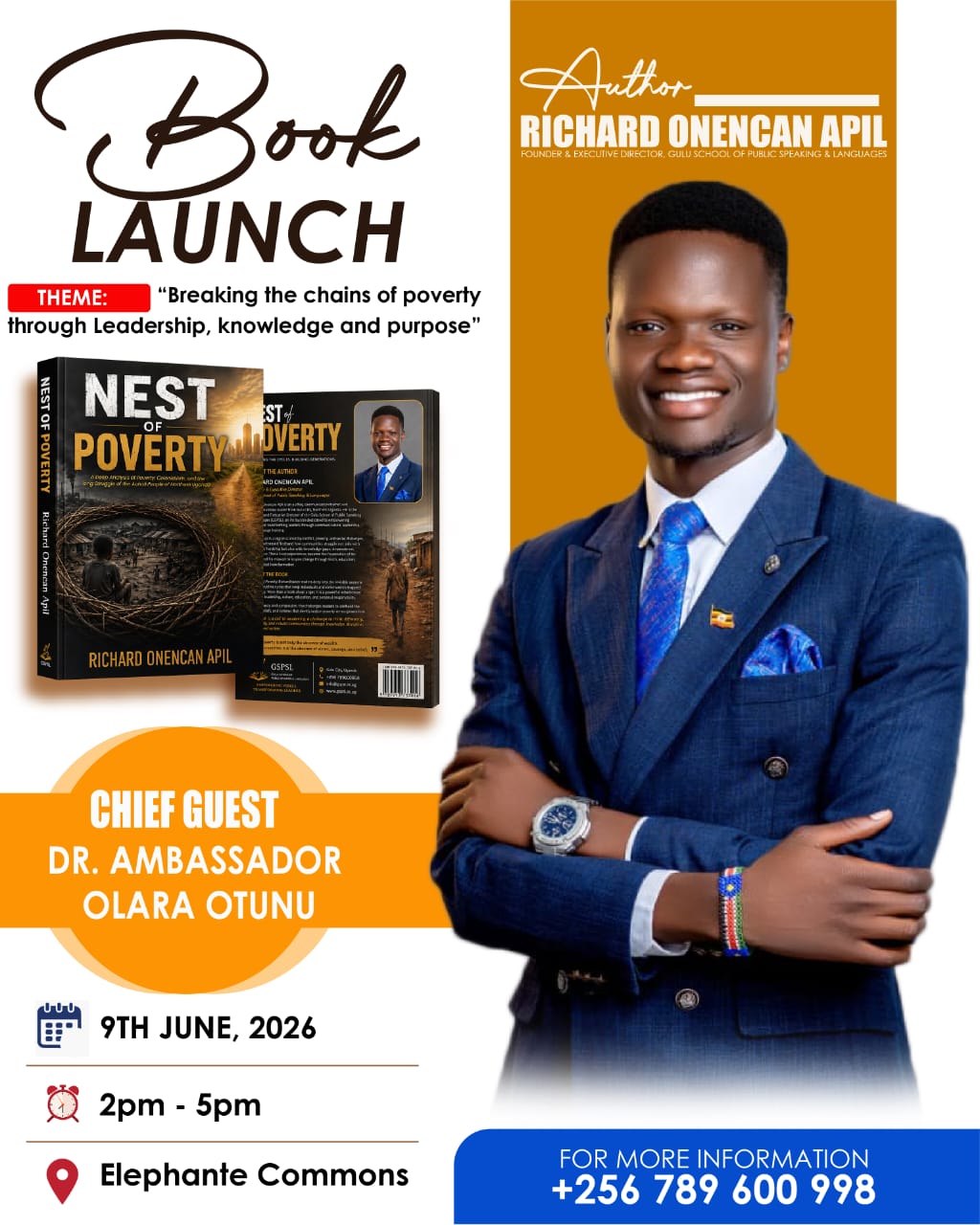
With the upcoming launch of his foundational book, Nest of Poverty, communication strategist and academic Richard Onencan Apil has delivered a searingly honest, deeply human narrative that confronts the intergenerational cycle of economic confinement. Written entirely from the inside of the geography it diagnoses, the text moves far beyond conventional storytelling. It serves as a rigorous socio-economic critique, a personal testimony, and a direct institutional indictment of the post-war development promises that arrive and dissolve like seasonal rain on dry earth.
What is the core thesis of Nest of Poverty and how does it challenge traditional developmental narratives?
Nest of Poverty functions as an intellectual mirror designed to disturb, move, and permanently realign the reader’s understanding of systemic marginalization. Apil explicitly rejects the sanitized language of international non-governmental organizations that reduce human suffering to palatable graphs and donor-funded statistics.
Instead, the narrative is populated entirely by the lived realities of human beings trapped within engineered constraints: the rural mother enduring a grueling six-kilometer trek for basic water security while her household waits, the brilliant young mind whose intellectual potential is systematically crushed by a lack of institutional infrastructure, and an entire community that has been conditioned by decades of displacement and false political promises to mistake systemic permanence for patient resilience.
Also read what he says about Balaalo
The book’s central argument is built on the premise that poverty in Northern Uganda is not an accidental, individual failure but a structured environment—a literal “nest” woven over generations by war, displacement, economic isolation, and institutional neglect.
By shifting the conversation away from passive victimhood to active structural accountability, Apil demands answers from local governance structures, the state machinery, and a society that has comfortably externalized the economic crisis of the north as someone else’s problem.
How has the author’s personal trajectory through Agago and Gulu shaped his academic perspective?
The analytical authority of Nest of Poverty is derived directly from the author’s rigorous biographical and educational journey through the red-earthed plains of the Acholi sub-region. Born and raised in Patango, Agago District, Richard Onencan Apil’s life is a case study in using education to dismantle localized limitations.
He sat his Primary Leaving Examinations (PLE) at Olung Primary School in Agago District in 2013, before advancing to complete his Uganda Certificate of Education (UCE) at St. Francis High School, Kalongo, in 2017. His academic pursuit brought him to Gulu City, where he finalized his Uganda Advanced Certificate of Education (UACE) at Gulu Senior Secondary School in 2019.
[Olung Primary School] ➔ [St. Francis Kalongo] ➔ [Gulu Senior Secondary School] ➔ [Gulu University Academic Matrix]
In 2020, Apil matriculated into Gulu University, graduating with a Bachelor of Arts in Education, majoring in Geography. This specific discipline—focused on the structural relationship between land, people, resources, and human environments—serves as the quiet intellectual baseline running through his entire literary style. To bring formal disciplinary execution to his communication skills, he is currently in his final year completing a Diploma in Journalism and Mass Communication at the East African Institute for Management Science.
Also read about Anita Among
Simultaneously, he is pursuing a second formal degree in International Relations and Security Studies at Gulu University, a dual-track academic profile that ensures his writing seamlessly synthesizes grassroots realities with complex global structural frameworks.
How is the Gulu School of Public Speaking and Languages transforming youth voice in the region?
Apil’s commitment to community transformation extends beyond the pages of his introductory book into the construction of sustainable local institutions. Recognizing that brilliance without expression remains suppressed, he founded and serves as the Executive Director of the Gulu School of Public Speaking and Languages (GSPSL), operating out of the creative hub of Elephante Commons in Gulu City.
Through this institution, Apil has mentored a new generation of young northern Ugandans, equipping them with the rhetorical precision, linguistic command, and intellectual confidence needed to articulate their community realities on national and international stages.
To further entrench this communicative infrastructure, he has expanded his entrepreneurial footprint by establishing the Gulu Media Academy alongside the Institute of Professional Marketing and Sales. These interlocking initiatives prove that Apil does not merely theorize economic liberation; he is actively manufacturing the exact human resource infrastructure required to challenge regional marginalization from within.
What is the strategic significance of Ambassador Olara Otunnu headlining the book launch?
The formal public unveiling of Nest of Poverty is scheduled to take place on Tuesday, June 9, 2026, from 2:00 PM to 5:00 PM at Elephante Commons, located on Plot 75 Jomo Kenyatta Road in Gulu City. Running under the definitive execution theme of “Breaking the chains of poverty through Leadership, knowledge and purpose,” the launch marks a major milestone for independent publishing in the country.
The event will feature a highly symbolic keynote address by the Chief Guest, Dr. Ambassador Olara Otunnu, the globally distinguished diplomat, lawyer, and former United Nations Under-Secretary-General for Children and Armed Conflict.
The selection of Ambassador Otunnu as Chief Guest carries profound institutional weight. As a historic leader of the Acholi people who has recently championed the Rocco Paco community revival initiative alongside other regional elders to rebuild the socio-economic fabric of Northern Uganda, Otunnu’s alignment with Apil’s literary work signals a major generational bridge.
By connecting the international diplomatic legacy of Otunnu with the raw, technocratic scholarship of Apil, the launch positions Nest of Poverty not merely as a solo literary milestone, but as a central text for the ongoing socio-political and structural reconstruction of the region.
How can the public engage with the author and secure copies of Nest of Poverty?
As Nest of Poverty prepares to hit the national market as the opening argument in what promises to be an extensive intellectual career, the author’s management desk has opened direct channels for academic institutions, policy think tanks, civic groups, and ordinary readers to secure copies and coordinate community engagements. Interested parties can access the book and connect with the author’s desk through the following verified networks:
- Physical Operations Desk: Elephante Commons, Plot 75 Jomo Kenyatta Road, Gulu City, Northern Uganda.
- Direct Telephony and Verification Line: +256 789 600 998
- Official Correspondence Channel: oyaroapillongom@gmail.com