

Table of Contents
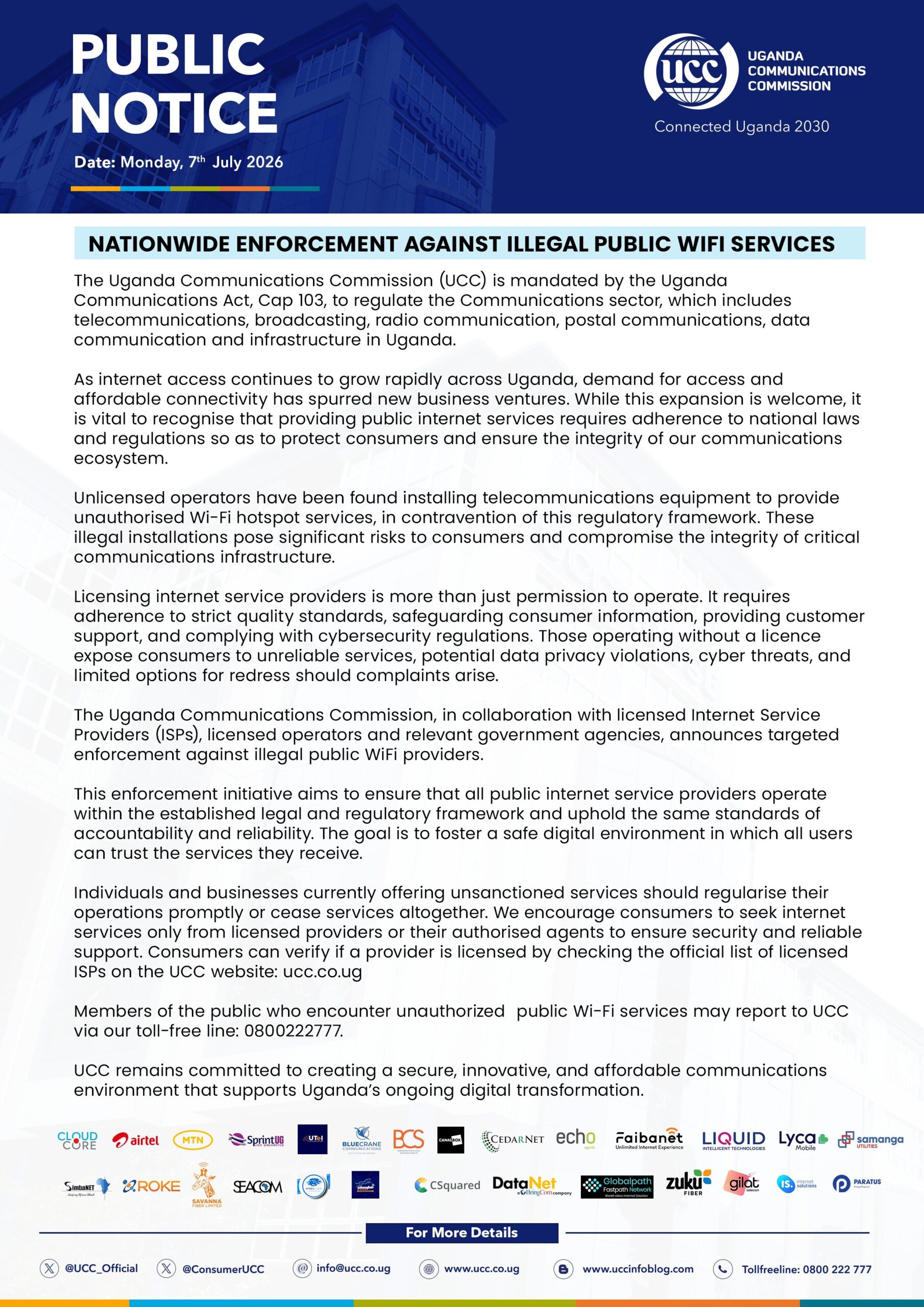
KAMPALA — The Uganda Communications Commission (UCC) has released an uncompromising public notice on Monday, 7th July 2026, launching a nationwide enforcement campaign to completely shut down unauthorized public WiFi hotspot providers.
While the regulatory body frames the sudden swoop as an essential campaign to enforce cybersecurity and protect consumer privacy under the Uganda Communications Act, Cap 103, everyday citizens and digital rights advocates are pushing back aggressively. Critics argue that the move represents a mix of corporate protectionism and an aggressive state tax grab aimed at dismantling a highly popular micro-economy that has provided cheap, accessible internet to low-income earners and students across the country.
What is the UCC public WiFi enforcement initiative?
The newly announced project is a sweeping, multi-agency regulatory crackdown designed to hunt down and dismantle unlicensed neighborhood and marketplace WiFi hotspot businesses. Over the past few years, an energetic informal tech economy has mushroomed across Uganda’s urban centers to bridge the digital divide.
Local tech entrepreneurs buy large internet data bundles from licensed Internet Service Providers (ISPs) at bulk wholesale rates. They then deploy affordable routing equipment—such as long-range hotspot routers—to split and resell that connectivity to the public at significantly cheaper rates than standard telecom data menus. The UCC’s directive explicitly outlaws these “data hawkers,” declaring the unauthorized installation of such telecommunications equipment a direct violation of national regulatory laws.
NTV Akawungeezi Goes Viral With New Remote Broadcast Success
When does the Uganda public WiFi crackdown start?
According to the official directive issued by the commission, the enforcement initiative is immediate and ongoing as of Monday, 7th July 2026. The UCC, in direct coordination with licensed telecom operators and relevant government agencies, has deployed tracking units to sweep urban markets, student residential hubs, and commercial streets. Unlicensed operators have been ordered to either regularize their paperwork promptly or pull down their routers immediately to avoid asset seizure and legal prosecution.
Why is the government cracking down on local WiFi hotspots?
From the official regulatory standpoint, the UCC maintains that licensing internet resellers is a national security and consumer protection mandate. The commission argues that operating outside the law exposes everyday users to unchecked cyber threats, identity theft, and severe data privacy violations with zero options for official legal redress.
“Licensing internet service providers is more than just permission to operate. It requires adherence to strict quality standards, safeguarding consumer information, providing customer support, and complying with cybersecurity regulations,” the UCC stated in its public notice.
However, the real driver behind the sudden crackdown stems from complaints by multi-billion-shilling corporate telecom monopolies. These licensed giants have registered revenue losses because their standard retail data menus simply cannot compete with the highly affordable rates offered by agile neighborhood hotspot vendors.
Why are critics accusing the UCC of corporate greed?
The aggressive sweep has sparked an intense public backlash, with critics pointing out a glaring double standard in how the government handles informal trade. In Kampala, the state routinely deploys law enforcement to evict physical street hawkers under the pretense that they litter the pathways, cause congestion, and create public disorder.
Yet, as critics point out, these digital “data hawkers” operate completely in the virtual space. A public WiFi signal takes up zero physical street space, creates no physical litter, and inconveniences absolutely nobody. Clients actively and voluntarily seek out these local sellers to buy cheap data vouchers because mainstream mobile internet costs remain prohibitively high for low-income earners.
Digital advocates argue that the state’s sudden obsession with “infrastructure integrity” is a convenient smokescreen designed to protect corporate profit lines and squeeze taxes out of a self-starting youth populace. Critics maintain that the government simply cannot tolerate seeing ordinary citizens innovate or make a modest profit without finding a way to forcibly bring them into a taxable bracket, even if it means plunging students and poor communities back into digital darkness.
Which internet service providers are legally licensed by the UCC?
To maintain full regulatory control, the UCC is running this enforcement operation hand-in-hand with the country’s licensed establishment. The official notice highlights a specific list of licensed operators and authorized Internet Service Providers (ISPs) that consumers are permitted to buy data from, including:
- Airtel Uganda
- Roke Telecom
- Lycamobile
- Liquid Intelligent Technologies
- Faibanet
- Seacom
- Zuku Fiber
- CSquared, Data Net, Globalpark, BCS, Cedarnet, Echo, Samanga, and SprintUE
How can neighborhood WiFi operators participate legally?
For local businesses currently running these unsanctioned hotspot zones, the UCC has given a strict ultimatum: regularize operations promptly or cease services altogether. To participate legally, informal vendors are required to formally apply for Capacity Resale or Voice and Data Service licenses under the UCC’s modified telecommunications framework, or register formally as authorized commercial agents of the corporate ISPs listed above.
Failing to transition into this heavily regulated framework will result in an immediate shutdown. For the general public, the UCC has requested citizens to actively monitor their own neighborhoods and report any unauthorized, low-cost community WiFi installations by calling their official toll-free reporting line at 0800 222 777.
Uganda press freedom and digital clampdown