
Table of Contents
When did she officially leave Swangz Avenue?
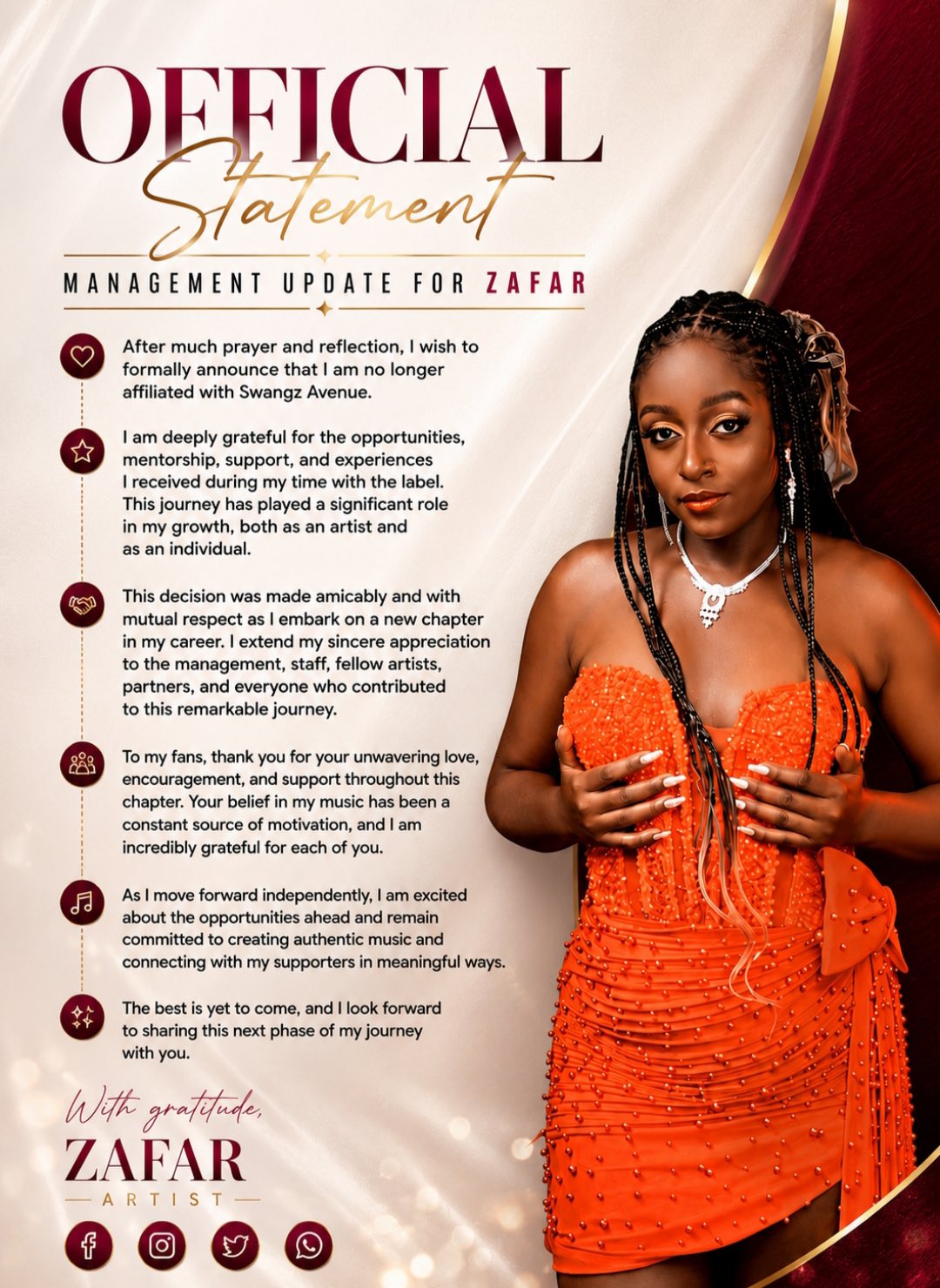
Ugandan songstress Josephine Nakyoonyi, widely recognized by her former stage moniker Zafaran, has officially cut ties with the powerhouse entertainment label Swangz Avenue. In an unexpected management statement delivered exclusively to Kampala Edge Times by entertainment journalist Erich Mboowa on Thursday, June 25, 2026, the vocal powerhouse announced that she is moving forward as an independent artist after spending over four years under the record label’s elite management wing.
Simultaneously, the singer has executed a complete corporate identity overhaul, changing her artistic brand name to ZAFAR. The sudden departure ends months of industry whispers surrounding her musical silence and marks an ambitious new chapter for one of the country’s most gifted vocal talents.
Who is Zafaran and when did she join Swangz Avenue?
Josephine Nakyoonyi is a contemporary Ugandan Afro-pop and R&B recording artist who first entered the commercial music industry as an elite background vocalist for top-tier musicians, including Juliana Kanyomozi and King Saha. Recognizing her exceptional vocal pitch and deep musical interpretation, the Industrial Area-based record label Swangz Avenue signed her to a multi-year management contract, officially unveiling her to the public on March 18, 2022.
Upon her high-profile debut, she instantly dropped her introductory single, Mwoto, which was quickly followed by heavy rotation tracks like Ankuba, Jeguli, and Sweetheart. Despite her undeniable vocal capabilities, her four-year run at the label was characterized by a slow, highly calculated release schedule that often left her fan base demanding more consistent mainstream visibility.
What are the reasons behind Zafaran’s split from Swangz Avenue?
The primary reason behind Zafaran’s split from Swangz Avenue stems from an amicable, mutual agreement to let her current contract expire without entering a renewal phase, following internal friction over her artistic positioning. For the past year, the singer had been noticeably quiet on the airwaves, fueling intense speculation that she felt structurally undervalued and sidelined by label executives.
Also read about the EVA movie from Swangz Avenue
Insiders close to the camp reveal that as the label expanded its corporate portfolio and shifted its primary promotional machinery toward newer projects, Nakyoonyi felt her standalone career was being systematically deprioritized. Rather than engaging in a messy public legal war, the artist chose to negotiate a clean administrative exit to regain total control over her masters, publishing rights, and distribution pipelines.
Official Statement from ZAFAR:
“After much prayer and reflection, I wish to formally announce that I am no longer affiliated with Swangz Avenue. I am deeply grateful for the opportunities, mentorship, support, and experiences I received during my time with the label. This journey has played a significant role in my growth, both as an artist and as an individual. This decision was made amicably and with mutual respect as I embark on a new chapter in my career. As I move forward independently, I am excited about the opportunities ahead and remain committed to creating authentic music.”
How has the artist rebranded her musical identity to ZAFAR?
To mark her complete transition from a restricted label signee to an autonomous independent creator, the singer has officially dropped the name Zafaran and rebranded as ZAFAR. The strategic name change is engineered to clear away the legacy image of a managed corporate product and introduce a bolder, more energetic indie brand to the global streaming market.
To support this shift, the singer has significantly adjusted her promotional strategy over the last few weeks, bypassing traditional media channels to engage directly with Ugandan music lovers via live TikTok interactions, acoustic sessions, and raw vocal breakdowns. By operating as ZAFAR, she aims to pivot away from strict bubblegum pop and experiment with alternative African sounds that showcase her unedited vocal range.
How does her exit compare to other artists joining or leaving Swangz Avenue?
The departure of ZAFAR highlights a recurring historical pattern within Swangz Avenue, where the label excels at launching explosive female talent but occasionally struggles with long-term roster retention once artists demand individual autonomy. Her exit mirrors the historic 2017 departure of Irene Ntale, who similarly left the label at the peak of her powers after expressing concerns that management was shifting its focus to a newly signed Vinka.
To understand how the label’s internal talent architecture is currently distributed following this major exit, review the roster breakdown below:
| Artiste | Status at Swangz Avenue | Key Milestone Track | Current Operational Posture |
| Winnie Nwagi | Active Roster (Longest Serving) | Musawo / Matala | Firmly at the label; consistently rejects rumors of exiting. |
| Vinka | Active Roster | Malaika / Bailando | Driving the label’s regional tour footprint and brand endorsements. |
| Azawi | Active Roster | Quinamino / Party Mood | Serves as the label’s premier creative asset and festival headliner. |
| Elijah Kitaka | Active Roster (First Male Act) | Nothing / Red Flag | Managing the label’s alternative R&B and live-band portfolio. |
| ZAFAR (Zafaran) | Exit (June 2026) | Ankuba / Sweetheart | Operating Solo; running independent digital distributions. |
While Swangz Avenue remains arguably the most successful and institutionally structured label in Uganda—recently attempting to expand its footprint through the Swangz All Star album collaborations—the loss of ZAFAR proves that the independent indie path remains highly attractive to vocalists who want to escape rigid corporate gatekeeping.
For Winnie Nwagi, who had publicly labeled Zafaran as her absolute favorite vocalist at the label due to her deep understanding of music, the exit represents a major loss of internal collaborative synergy. For ZAFAR, however, the corporate chains are officially gone, and the entire Ugandan music fraternity is watching closely to see if her independent catalog can deliver the definitive breakthrough that eluded her for four years.