
Table of Contents
Kampala, Uganda — Airtel Africa plc has released its results for the nine-month period ended 31 December 2025, revealing a significant acceleration in both digital adoption and financial performance. The telecommunications giant reported a robust 28.3% jump in reported revenue, driven by a landmark quarter for its fintech arm, Airtel Money, and a surge in data consumption across the continent.
The results, released on January 30, 2026, paint a picture of a company capitalizing on aggressive network investment and a deepening smartphone ecosystem.
What are the headline financial figures?
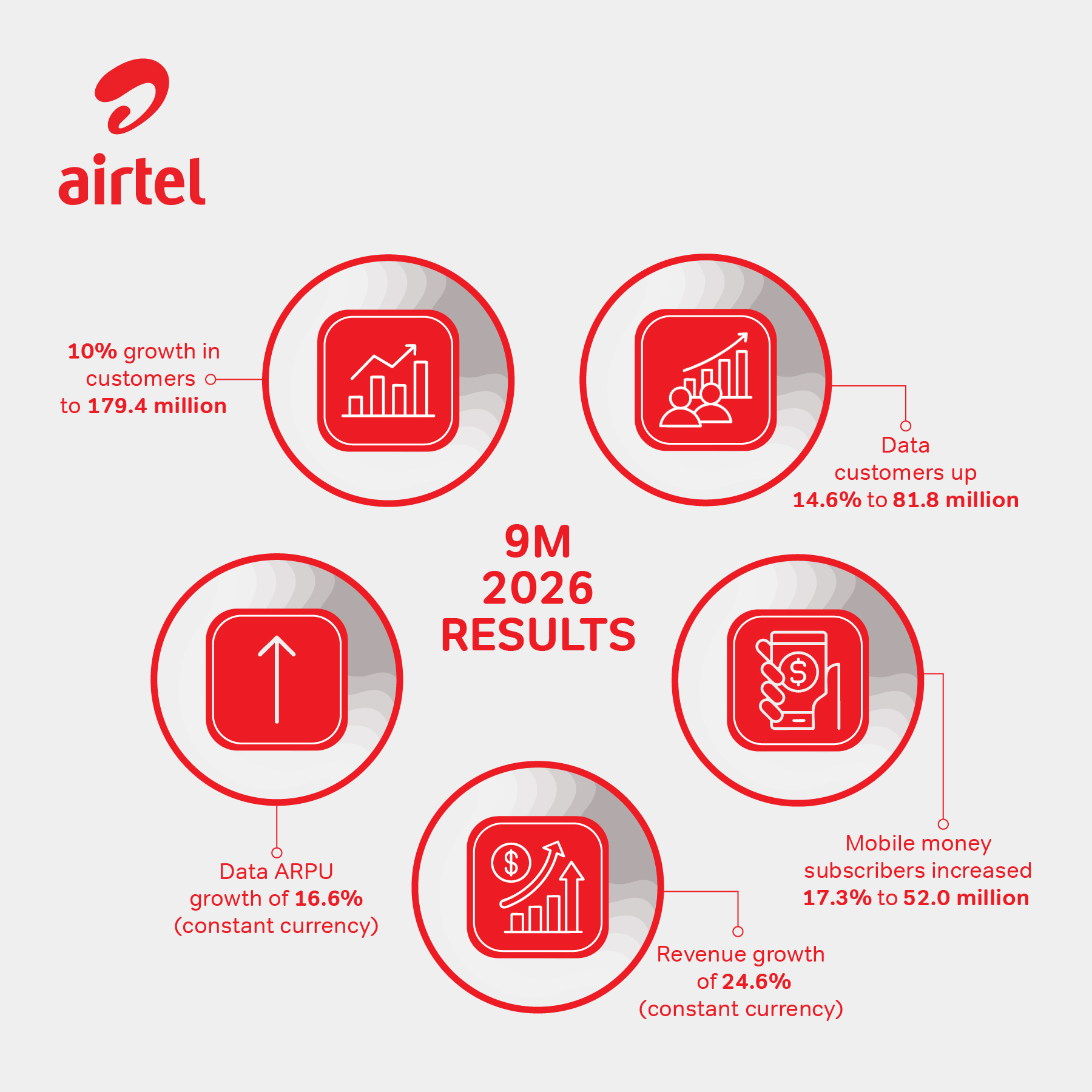
The financial topline is remarkably strong. Airtel Africa reported revenues of $4,667 million, marking an increase of 24.6% in constant currency and an impressive 28.3% in reported currency.
A critical factor in this reporting period was the currency environment. Unlike previous quarters often plagued by volatility, the report notes that “currency appreciation supported the strong underlying fundamentals of the business,” providing a tailwind to the reported figures. This stability has allowed the operational gains to shine through clearly in the dollar-denominated results, validating the company’s strategy in its key markets.
How is the customer base expanding?
The operator’s reach continues to widen at a double-digit pace. The total customer base grew by 10% year-on-year, reaching a massive 179.4 million subscribers across its footprint.
However, the composition of this growth tells a more specific story of modernization. The growth isn’t just in voice; it is heavily skewed toward high-value segments. Data customers grew faster than the overall base, rising by 14.6% to reach 81.8 million. This shift is crucial for long-term sustainability, as legacy voice revenues generally plateau across the industry while data demand remains elastic and growing.
What is driving the surge in data consumption?
The report highlights a “customer-centric strategy” underpinned by increased network investment. This infrastructure spend is directly translating into user behavior changes.
Data usage per customer has spiked significantly. The average customer now consumes 8.6 GB per month, up from 6.9 GB in the prior period. This increase is facilitated by higher smartphone penetration, which rose by 3.9% to reach 48.1%.
Essentially, nearly half of the network’s users are now on smartphones, consuming heavier content like video and streaming services. Consequently, the Data Average Revenue Per User (ARPU) grew by 16.6% in constant currency.
How is Airtel Money reshaping the fintech landscape?
Perhaps the most striking details in the Q3 report come from the fintech division. Airtel Money has crossed two historic thresholds this quarter, solidifying its position as a dominant financial ecosystem in Africa.
- Subscriber Milestone: The service exceeded the 50-million mark, growing 17.3% to reach 52.0 million customers.
- Transaction Volume Milestone: The annualised Total Processed Value (TPV) surpassed the $200 billion threshold for the first time. TPV rocketed by 36% to over $210 billion.
These figures suggest that Airtel Money is moving beyond simple peer-to-peer (P2P) transfers and becoming a primary transaction layer for the economy. The “broader ecosystem and stronger digital adoption” mentioned in the report contributed to a 9.8% increase in constant currency ARPU for the mobile money segment.
What are the strategic priorities moving forward?
The management attributes this momentum to tangible progress in their strategic priorities: digitization, network investment, and innovative new partnerships.
The report emphasizes that the “enhanced network investment” (likely referring to 4G and 5G rollouts identified in the glossary as ‘LTE’ and ‘5G’) is the bedrock of these results. By improving the Quality of Service (QoS), the telco has been able to capture the rising demand for high-speed internet.
Looking ahead, the focus appears to remain on scaling the “Win with” strategy—winning with network, distribution, and data. With the mobile money arm now processing over $210 billion annually, the potential for separating or further monetizing the fintech asset remains a key narrative for investors to watch in 2026.
Would you like me to draft a follow-up social media post or a bulleted summary of these results for your editorial team?